 Metti
How to Budget When You Live Paycheck to Paycheck

Stop budgeting by the month and budget by the paycheck. Each payday, list every bill due before the next one, cover those and your basics first, then divide what’s left by the days until you get paid again. If one paycheck is always tight and the other is loose, set money aside from the loose one to even them out.
It’s Wednesday. Payday is Friday. You have $31 and you’re doing math in your head at the gas pump: half a tank now, groceries can wait until the weekend, and that one bill is going to have to sit for two more days.
If you’ve done that math, you already know how to budget. You’re just doing it at the last minute, under pressure, with no room to move.
Living paycheck to paycheck doesn’t mean you’re bad with money. Plenty of people working full time, some of them with good salaries, are one payday away from zero. Usually it means the gap between what comes in and what has to go out is small, and the timing is working against you. You can’t always change the gap overnight. You can change the timing this week.
Why a monthly budget doesn’t work when money is tight
Most budgeting advice starts with “add up your monthly income and your monthly bills.” On paper that can look fine. You make more than your bills cost. So why are you short every other week?
Because you don’t get paid by the month, and your bills don’t wait for the month to end. Rent is due on the 1st whether your big paycheck landed or not. A monthly budget hides that. It tells you the totals work. It doesn’t tell you about the days when they don’t.
When money is tight, the question isn’t “can I afford my month?” It’s “can this paycheck make it to the next one?”
So shrink the budget down to the size of your real life: one paycheck at a time.
Step 1: List what’s due before your next payday
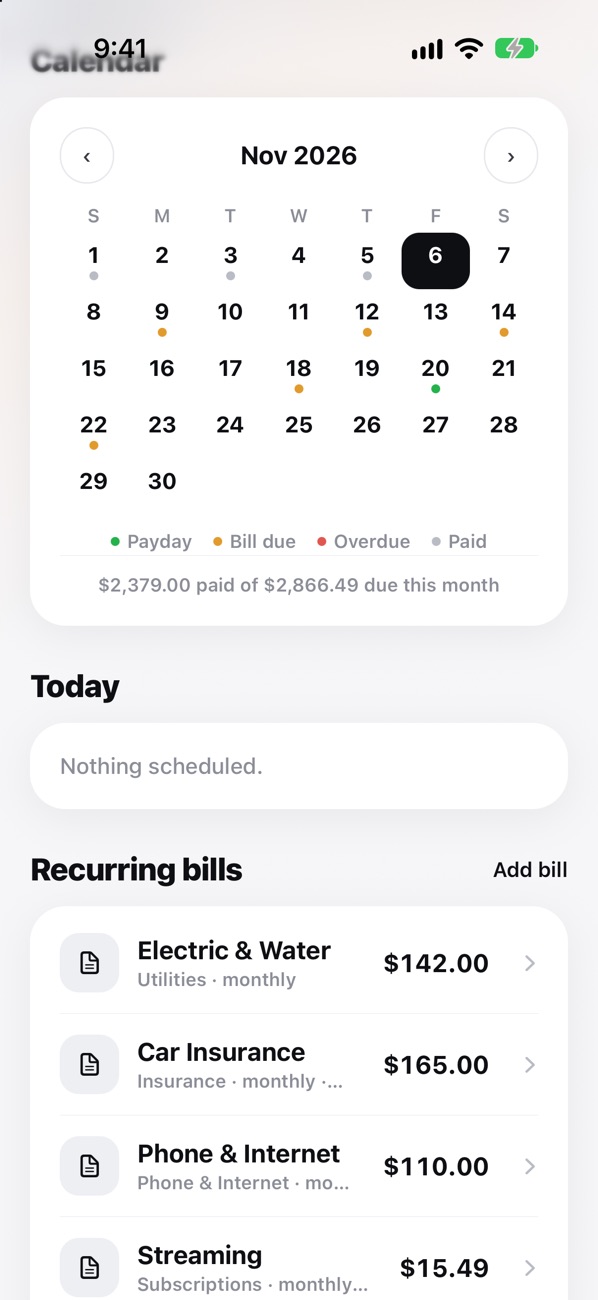
On payday, before you spend anything, write down every bill that’s due between today and the next time you get paid. Not the whole month. Just this stretch.
Check the due dates one time and write them down: rent, phone, electric, insurance, card minimums, the subscription that renews on the 14th. If you’re not sure what you’re even paying for, a 30-day look at where your money goes will find it.
Step 2: Cover the basics first
When there isn’t enough to go around, the order matters more than the amount. Pay in this order:
- A roof and the lights. Rent or mortgage, electric, water, heat.
- Food. Groceries, not delivery.
- Getting to work. Gas, the bus pass, the car payment and insurance. This protects the next paycheck.
- Minimums on what you owe. Paying at least the minimum keeps late fees from piling on.
- Everything else.
Step 3: Turn what’s left into a daily number
Take the paycheck, subtract the bills from Step 1, and divide what’s left by the number of days until you get paid again.
(Paycheck − bills due before next payday) ÷ days until next payday = what you can spend per day
That number covers gas, groceries, lunch, and everything that isn’t a bill. We go deeper on this in how much can I spend today?
Here’s an example with made-up numbers. Say you bring home $1,400 every two weeks:
| The rent paycheck | The other paycheck | |
|---|---|---|
| Take-home pay | $1,400 | $1,400 |
| Bills due before next payday | $1,010 (rent $950, phone $60) | $400 (electric $90, car insurance $140, internet $50, card minimum $45, bus pass $75) |
| What’s left | $390 | $1,000 |
| Per day, over 14 days | $27.86 | $71.43 |
Same job, same pay, and one half of the month you have $27.86 a day while the other half you have $71.43. That’s why it feels like you’re fine and then suddenly you’re not.

Step 4: Even out the lopsided paychecks
The loose weeks feel like extra money, so it gets spent. Then the rent paycheck shows up and there’s nothing to lean on. The fix is to move money from the loose paycheck to the tight one, on purpose. In the example, set aside $300 from the other paycheck for next month’s rent:
- The rent paycheck: $390 + $300 = $690, or $49.29 a day.
- The other paycheck: $1,000 − $300 = $700, or $50.00 a day.
You didn’t earn a dollar more. You didn’t cut anything. But now every day of the month looks about the same, and about $50 a day is a lot easier to live on than $71 followed by $28.
Another way to do the same thing: ask to move a due date. Many card companies, lenders and utilities will change it if you call or check the app, and moving one bill to the lighter paycheck can balance things out.
Real talk: the money from the loose paycheck isn’t extra. It’s the rent paycheck’s money that showed up early.
Step 5: Build a small buffer, even $10
The worst part of living paycheck to paycheck is that anything unexpected breaks the plan. A flat tire, a prescription, a kid’s field trip. So the first savings goal isn’t three months of expenses. It’s a little cushion between you and zero.
Pick an amount you won’t miss and treat it like a bill, every payday:
$260 won’t change your life. It can cover a small surprise without you missing a bill, and that’s where breathing room starts. If you want ideas for finding that $10, here are small ways to save money every day.
What to do when the math doesn’t work
Sometimes you do Step 1 and the bills are bigger than the paycheck. That’s hard to look at. It’s still better to see it on payday than to find out on the due date.
- Protect the basics. Housing, utilities, food and getting to work come first.
- Call before it’s late. Ask for a later due date, a payment plan, or whether they have a hardship option. Companies have more room to work with you before you’ve missed a payment than after.
- Be careful with quick cash. Anything that gives you part of your next paycheck early, for a fee, makes the next paycheck smaller. Read the cost before you agree.
- Look for local help. In most of the U.S., dialing 211 connects you with local programs for rent, utilities and food. Using help that exists for this is a smart move, not a failure.
If the numbers are short every single pay period, moving money around won’t fix it. The answer is a wider gap: a lower bill, more hours, a raise, a different job, a side income. A budget won’t create that for you, but it will show you exactly how big the gap is.
Keep it going: ten minutes every payday
This isn’t a system you have to live inside. It’s a ten-minute habit:
- List what’s due before the next payday.
- Pay or set aside the basics and the bills.
- Move your set-aside and your buffer.
- Divide what’s left by the days. That’s your number.
Then check the number once a day. Go over on Monday and it gets a little smaller for the rest of the stretch. Go under and it grows. Either way you know, and knowing is the opposite of doing math at the gas pump.
This is the kind of math Metti is built to do for you. It works out a daily number from your income, your bills and a savings goal, and updates it as you log spending, scan a receipt, tell it in chat, or connect your bank (read-only through Plaid, it never moves your money). Metti is launching on iPhone soon.
Common questions
Can you budget if there’s nothing left over?
Yes, and that’s when it helps most. A budget doesn’t need extra money to work. Its job is to decide the order your money goes out in, so the important things get paid first and nothing catches you off guard.
Should I budget monthly or by paycheck?
If money is tight, by paycheck. A monthly budget can balance on paper while you still run short in the days before payday, because the bills and the paychecks don’t land at the same time. Budgeting by paycheck matches the plan to when the money is really there.
How much of a buffer do I need?
Start with whatever you can leave alone, even $10 a paycheck. The first goal isn’t a big emergency fund. It’s having enough that a small surprise doesn’t throw off the whole pay period.
What if my bills are more than my paycheck?
Then the plan has shown you something real, and it’s better to know before the due date than after. Cover housing, utilities, food and getting to work first. Then call the companies you owe before the bill is late and ask about a later due date or a payment plan. Longer term, the fix is a bigger gap between what comes in and what goes out, from either side.
This article is general education, not financial advice. Your situation is your own; for decisions about debt, taxes or investing, talk to a qualified professional.
 How Much Can I Spend Today? The Daily Budget Method
 How to Save Money Every Day: 12 Small Habits That Work
 Where Does My Money Go? How to Find Out in 30 Days