 Metti
Where Does My Money Go? How to Find Out in 30 Days

To find out where your money goes, write down every single thing you spend for 30 days, sort it into a handful of categories, and add it up. Most people find the answer in three places: bills they stopped noticing, small stuff they buy all the time, and “surprise” costs that actually happen every year.
You got paid on Friday. You didn’t buy anything crazy. No trip, no TV, no new phone. And somehow, with a week still to go, you’re checking your balance before you buy lunch.
So where did it go?
If that’s you, you’re not bad with money, and you’re not alone. Most of us never had anybody show us how to track it. We just knew when it was there and when it wasn’t. The usual advice is “be more disciplined,” but that skips a step. You can’t fix what you can’t see. This is a 30-day way to see it, and it starts with not changing a single thing.
Why money seems to disappear
It’s almost never one big mistake. It slips out in ways that are easy to miss:
- Paying takes one second. Tap, done. It barely feels like a decision, so it doesn’t stick in your memory.
- Small and often beats big and rare. You remember the $400 car repair. You don’t remember eleven $9 purchases, and that’s about a hundred dollars.
- Subscriptions run in the background. They were designed to be forgotten. They renew whether you opened the app or not.
- Sending money is too easy. Twenty here to split the food, forty there because somebody needed it. Looking out for your people matters. It still counts as spending.
- “Surprises” that aren’t surprises. Birthdays, holidays, car trouble, the yearly fee. They’re not monthly, so they never make the plan. They still show up every single year.
None of that makes you irresponsible. It’s just how spending works now. Everything is set up to be smooth. The fix is a clear picture.
The mindset shift: look first, change later
Here’s why most people quit tracking in week one. They try to track and cut back at the same time. So every time they write something down, it feels like getting caught. And nobody keeps looking at something that makes them feel bad.
So make a deal with yourself. For 30 days, you’re only watching. Nothing is “bad.” Nothing gets cut. You’re just collecting the facts on your own life.
A budget isn’t a punishment. It’s a map. And you can’t use a map until you know where you’re standing.
That one shift is what makes it last. And here’s the thing: just knowing changes how you move. You’ll catch yourself making different choices without a single rule.
Step 1: Pick one way to track, and stick with it
The best method is the one you’ll still be doing in week three. Pick one:
- The notes app on your phone.
- A simple spreadsheet.
- Going through your bank and card statements once a week.
- An app that reads your receipts or your bank activity for you.
Whatever you choose, keep it under two minutes a day. If it takes longer than that, you’re not going to keep doing it. Be honest with yourself about that.

Step 2: Write down everything for 30 days
Everything means everything. The cash. The money you sent your sister. The gas station snack. The app that renewed while you were asleep. The small stuff is the whole point, because that’s exactly what your memory drops.
Write it down when it happens, or at the same time every night. Don’t try to rebuild the whole week on Sunday. You’ll lose the very purchases you’re trying to find.
Step 3: Sort it into a few buckets
When the 30 days are up, put every purchase into one of these:
- Housing and utilities
- Groceries
- Eating out and coffee
- Getting around (gas, rides, transit)
- Subscriptions
- Shopping
- Fun
- Everything else, including money you sent people
Keep it rough. You’re looking for the shape of your spending, not doing your taxes. Then add up each bucket.
Step 4: Find the three leaks
Almost every “where did it go?” comes down to one of these:
| The leak | What it looks like | What to do |
|---|---|---|
| Bills you stopped noticing | Subscriptions you don’t use, a phone plan you outgrew, insurance you haven’t shopped around in years. | Cancel or call once. You keep that money every month after, with zero extra effort. |
| Small and often | Coffee, delivery fees, snacks, rides, in-app purchases. | Pick a number you’re good with, on purpose. |
| “Surprises” on a schedule | Gifts, holidays, car repairs, yearly fees, trips, school costs. | Add up the year, divide by 12, set that aside every month. |
The small-and-often leak is the one that shocks people, so do the math one time:
Nobody’s telling you to stop buying it. If it makes your morning, keep it. The point is that now you know what it costs, and you get to decide if it’s worth that. That’s the difference between spending and leaking.
Step 5: Decide. Don’t just cut.
Go down your totals and mark each one keep, trim or cut.
The goal was never to spend as little as possible. That’s not living. The goal is to spend on purpose. If linking up with your people over food is the best part of your week, keep it, and trim something you don’t even care about.
Real talk: money that goes to what you value isn’t a leak. Money that goes to things you forgot you were paying for is.
Step 6: Turn it into one number you check every day
Thirty days of tracking shows you where your money has been going. The next step is knowing where it’s going from here on, without writing down every purchase for the rest of your life.
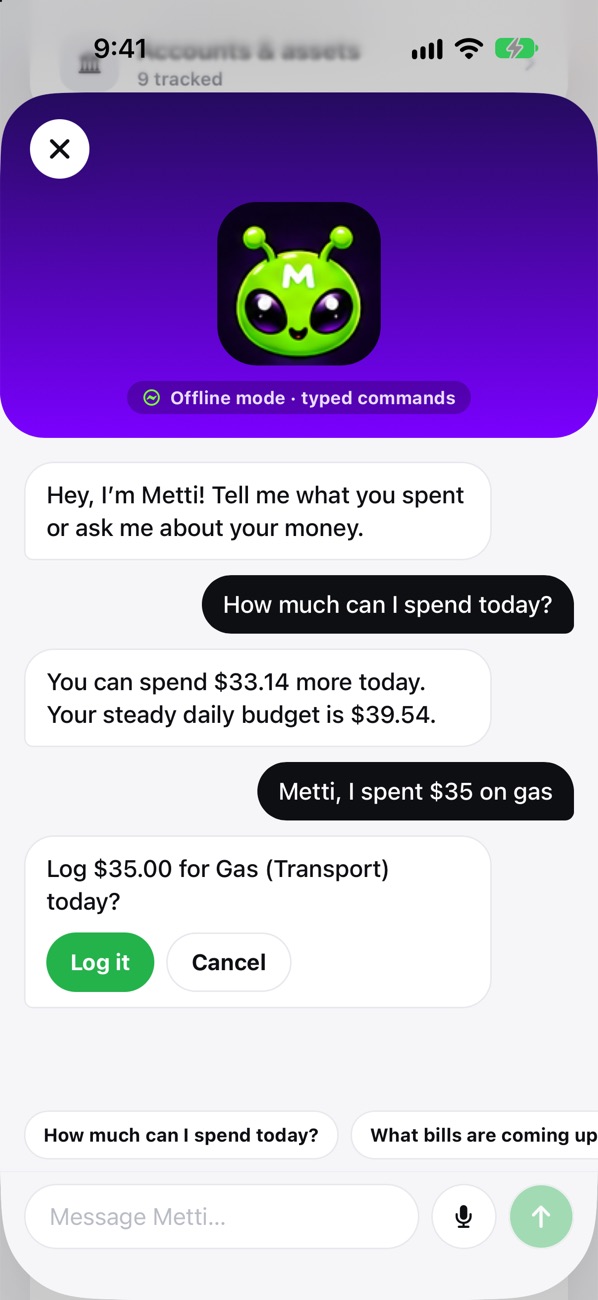
The simplest way is a daily number: take your income, subtract your bills and savings, and divide what’s left by the days in the month. We break down the math in how much can I spend today?
How to stay on top of it without tracking forever
- Every day, two minutes: look at what you spent and what’s left.
- Every week, ten minutes: check the week’s total and anything that surprised you.
- Every month: look at your subscriptions and any bill that changed.
- Twice a year: run the full 30 days again. Life changes, and the leaks move.
This is the job Metti was built for. Snap a receipt, tell Metti what you spent in a sentence, or connect your bank (read-only, it can’t move your money), and it keeps the picture current and shows you what’s safe to spend today. And when you’re ready to put the money you found to work, here are 12 small ways to save money every day.
Common questions
How long should I track my spending?
Thirty days. That’s long enough to catch a full round of bills and paychecks. After that you can stop writing down every purchase and switch to a quick daily check, as long as you run the full 30 days again once or twice a year.
Do I have to track cash and money I send to people?
Yes, for the 30 days. Cash and the money you send friends and family are the easiest to lose track of, because they don’t show up as a store name on your statement. Write it down the moment you send it.
What categories should I use?
Six to eight is plenty: housing and utilities, groceries, eating out and coffee, getting around, subscriptions, shopping, fun, and everything else. If “everything else” gets bigger than about a tenth of your spending, something’s hiding in there. Pull it out and name it.
Is it normal to not know where my money goes?
Completely. Tapping your phone, autopay and subscriptions are all built to be effortless, and effortless is easy to forget. Not knowing isn’t a character flaw. It’s a visibility problem, and you can fix that in a month.
This article is general education, not financial advice. Your situation is your own; for decisions about debt, taxes or investing, talk to a qualified professional.
 How Much Can I Spend Today? The Daily Budget Method
 How to Save Money Every Day: 12 Small Habits That Work