 Metti
How Much Can I Spend Today? The Daily Budget Method

Take what you bring home, subtract your bills, your minimum debt payments and what you want to save, then divide what’s left by the number of days it has to last. That’s your daily budget: what you can spend today on everything else without touching money that’s already spoken for.
You know the move. You’re in line, the total comes up, and before you tap your card you open the bank app real quick. Just to see. Just to make sure it’s not about to be embarrassing.
Most of us were never taught another way. Nobody sat us down and said “here’s how to know what you can spend.” Money was the thing the grown folks stressed about, not the thing they explained. So we learned to check the balance, do some quick math, and hope.
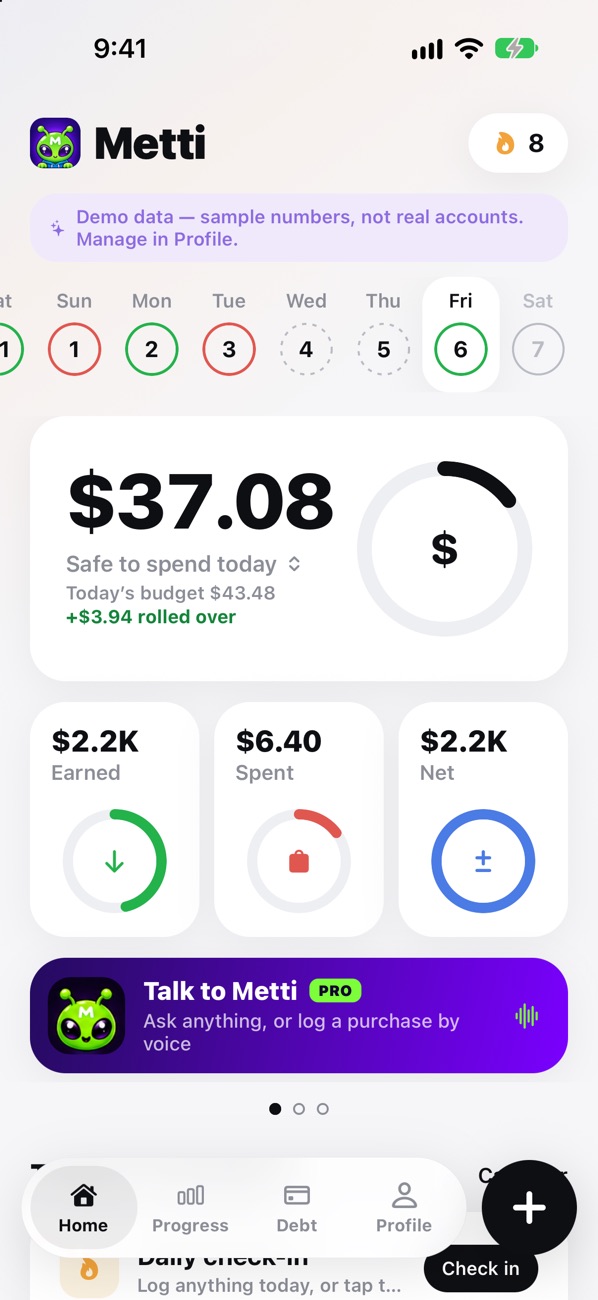
There’s a better question than “what’s in my account?” It’s “how much can I spend today?” One number. You can keep it in your head, and it’s already done the math on your rent, your bills and your savings. Here’s how to get yours.
Why your balance lies to you
Your balance tells you what’s in the account. It doesn’t tell you what’s yours.
If you’ve got $900 in checking and rent is $850 on the first, you don’t have $900. You’ve got $50 and a rent payment that’s holding the rest hostage. The balance looks like freedom, and that’s exactly how people end up short. Not because they’re reckless. Because the number they’re looking at isn’t the real one.
Your balance is what the bank is holding. Your daily number is what you can actually touch.
What a daily budget is
A daily budget is what you can spend each day on everyday life, after everything you’ve already committed to is set aside. Committed means your bills, your minimum debt payments and your savings. What’s left is yours, and breaking it down by the day makes it small enough to actually steer.
No ten categories. No spreadsheet. One number that says: this much is safe today.

The daily budget formula
You only need four things:
- Income: what actually hits your account after taxes. Not your salary, your take-home.
- Bills: rent, lights, phone, internet, insurance, subscriptions. Anything that’s about the same every month.
- Debt minimums: the minimum payments on your cards and loans.
- Savings: what you want to put up. Treat it like a bill you owe yourself, because that’s what it is.
(Income − bills − debt minimums − savings) ÷ days = your daily number
Do it for the month and divide by 30, or do the whole year and divide by 365. The yearly way is a little more accurate, because it makes room for the bills that only show up once a year.
Let’s run the numbers
Say you bring home $3,400 a month. Here’s where it goes before you spend a dollar on yourself:
| What | Per month |
|---|---|
| Take-home pay | $3,400 |
| Rent | −$1,250 |
| Lights, phone and internet | −$210 |
| Car insurance | −$120 |
| Subscriptions | −$40 |
| Minimum debt payments | −$180 |
| Savings (pay yourself) | −$300 |
| Left for everyday life | $1,300 |
That $43.33 covers everything that’s not on the list: groceries, gas, lunch, the barbershop, your cousin’s birthday, the thing you forgot you needed. It sounds small until you notice how many days cost you nothing. Those quiet days are what pay for the big ones.
Bills that don’t come every month
Here’s what gets people: the bills that aren’t monthly. Car registration. The yearly subscription. Insurance you pay twice a year. They feel like surprises, but they’re on a schedule. You just weren’t counting them.
Add them up for the year, divide by 12, and count that as one more monthly bill. A $600 yearly premium is really a $50 monthly bill you’re paying ahead of time. Now it can’t sneak up on you.
Paid weekly, every two weeks, or it changes?
Every two weeks: you get 26 checks a year, not 24. Multiply one check by 26 and divide by 12 for your real monthly number. A $1,600 check is $41,600 a year, about $3,467 a month.
Weekly: multiply by 52, divide by 12.
Tips, gigs, commission, or you work for yourself: build your number on a slow month, not a good one. When a good month comes, the extra is a bonus. Save it or throw it at debt. Don’t give yourself a raise off one good week.
What happens when you go over
You’re going to go over sometimes. That’s not failing. That’s having a life. What matters is what the budget does next.
Option one: start fresh every day. Tomorrow you get the same number again, no matter what happened today. Simple, but if you keep going over, the month slowly gets away from you.
Option two: spread it out. Whatever you went over (or under) gets shared across the days you have left. Say your number is $43.33, you spend $60 at dinner, and there are 20 days left in the month. You’re $16.67 over, which is about 83 cents a day. Your number goes to around $42.50. That’s it. One night out didn’t wreck anything.
And it works the other way too. Spend $20 on a $43.33 day, and the $23.33 you didn’t touch lifts every day you have left.
Real talk: this is what changes how budgeting feels. A bad day stops being something you have to “recover” from and feel guilty about. It’s just a small adjustment you can see.
Daily budget vs. monthly budget vs. 50/30/20
These aren’t competing. The 50/30/20 guideline (about half of your take-home for needs, 30% for wants, 20% for savings and debt) is a way to check if your plan is balanced. A monthly budget is the plan itself. A daily budget is how you carry that plan in your pocket.
If monthly budgets never stuck for you, skip the categories and start with the daily number. That’s enough to change things.
Five mistakes that throw your number off
- Using your pay before taxes. Budget with what actually lands.
- Leaving out the yearly bills. They’re coming regardless, and they’ll take it all at once.
- Leaving out savings. If you only save what’s left over, there’s never anything left over.
- Treating the number like a goal. It’s a ceiling, not a target. Coming in under is the win.
- Only checking after you spend. The number works before the purchase, not as a grade at the end of the day.
Get your number today
- Write down your take-home pay for the month.
- List every bill, including the yearly ones divided by 12.
- Add your minimum debt payments and a savings amount. Even $25 counts.
- Subtract, then divide by 30. That’s your number.
- Check it every morning, and before anything you didn’t plan to buy.
Not sure where your money’s even been going? Spend 30 days finding out first.
You can do all of this by hand, and it works. The hard part is keeping it up, because the number moves every time you spend. That’s what Metti is for: it works out your daily number from your income, bills and savings goal, then keeps it current when you log a purchase, snap a receipt or connect your bank. Once your number is working for you, the next move is saving a little of it every day.
Common questions
Is a daily budget better than a monthly budget?
They do different jobs. A monthly budget is the plan. A daily budget is how you follow the plan when you’re actually out here spending. Most people who can’t stick to a monthly budget don’t have a planning problem. They have a “Tuesday at lunch” problem, and a daily number is built for exactly that.
Should groceries be a bill or come out of my daily number?
Either works, as long as you pick one and stay consistent. If your grocery spending is steady, treat it like a bill and subtract a fixed amount each month. If it swings a lot, leave it in the daily number so you see it every time you shop.
What is a good daily budget?
There’s no magic number, because it depends on your income, your bills and what you’re trying to save. A good daily budget covers your real life, still leaves room for savings, and is one you can actually stick to most days.
What if my daily number comes out tiny, or negative?
Then the number is doing its job: it’s telling you the truth. It means your bills and savings goal are bigger than your income right now. Look at your biggest bills first, lower the savings goal for a while if you have to, and rebuild from a number that’s honest. No shame in it. You can’t fix what you won’t look at.
This article is general education, not financial advice. Your situation is your own; for decisions about debt, taxes or investing, talk to a qualified professional.
 How to Save Money Every Day: 12 Small Habits That Work
 Where Does My Money Go? How to Find Out in 30 Days