 Metti
How to Save Money Every Day: 12 Small Habits That Work

The most reliable way to save money every day is to decide the amount first and make it automatic: move money to savings the day you get paid, give yourself a daily spending number, and send whatever you didn’t spend to savings at the end of the day. Small amounts stack up fast. $5 a day is $1,825 a year.
Let’s clear something up first. Saving money is not about being cheap. It’s not skipping every night out, splitting the check down to the penny, or never buying yourself anything nice.
Saving is about options. It’s the difference between a flat tire being an annoying Tuesday and a flat tire being a crisis. It’s being able to say yes to the opportunity, no to the job that’s draining you, and “I got it” when your people need you. That’s what we’re really building here.
And it doesn’t take a big salary or a perfect month. It takes a few small moves you repeat until they’re automatic. Here are 12 of them, plus the math on why they work.
Small money adds up faster than you think
Before the habits, look at what a few dollars a day turns into:
Nobody notices $5 leaving. But $1,825 sitting in an account? You notice that. That’s the whole strategy: make the amount too small to hurt and too steady to fail.
Habits 1 to 4: Make saving automatic
1. Pay yourself first, the day you get paid
Set up an automatic transfer to savings for the same day your check lands. If you wait to see what’s left at the end of the month, the answer is always nothing. Money you never see in checking is money you don’t miss.
2. Know your daily number
Figure out what you can spend each day after bills and savings, and check it before you buy. It takes two seconds and it stops most overspending before it happens. Here’s how to work out your daily number.
3. Sweep the leftovers
If your number was $43 and you spent $31, move the $12 to savings that night. Leftover money that stays in checking gets spent. It always does.
4. Give your savings a name
“Savings” is easy to dip into. “Emergency fund,” “Moving out” or “Mom’s birthday trip” is not. Name the account for what it’s for, and you’ll think twice before touching it.

Habits 5 to 8: Stop the easy leaks
5. Wait 24 hours on anything you didn’t plan
Pick a line, say $50. Anything over it that you didn’t plan to buy, you wait a day. If you still want it tomorrow, cool, get it. Most of the time the feeling is gone by morning.
6. Check your subscriptions once a month
Go down the list and ask one question for each: did I use this in the last 30 days? If not, cancel it. You can always sign up again. This is the easiest money you’ll ever get back, because you cancel once and keep saving every month.
7. Take your card off the apps
Remove your saved card from the food and shopping apps, and turn off their notifications. One-tap checkout exists for a reason: the easier it is to pay, the more you spend. Make yourself type the card number and half those orders never happen.
8. Pack one meal you’d normally buy
Not all of them. One. If lunch out is $12 and lunch from home is $4, that’s $8 saved. Do it three days a week and you’ve kept about $1,250 by the end of the year, and you still ate out the other days.
Habits 9 to 12: Think different about spending
9. Turn prices into hours
If you take home $18 an hour, a $90 pair of shoes costs you five hours of your life. Sometimes that’s worth it. Sometimes it really isn’t. Either way, now it’s a real decision.
10. Take one no-spend day a week
One day where you spend nothing outside of bills. Eat what’s in the house, find something free to do. It’s a small reset, and it proves to you that you’re the one in control.
11. Shop with a list
Decide what you’re getting before you walk in or open the app. The store is designed to sell you what you didn’t come for. A list is how you leave with what you needed and nothing else.
12. Keep the streak going
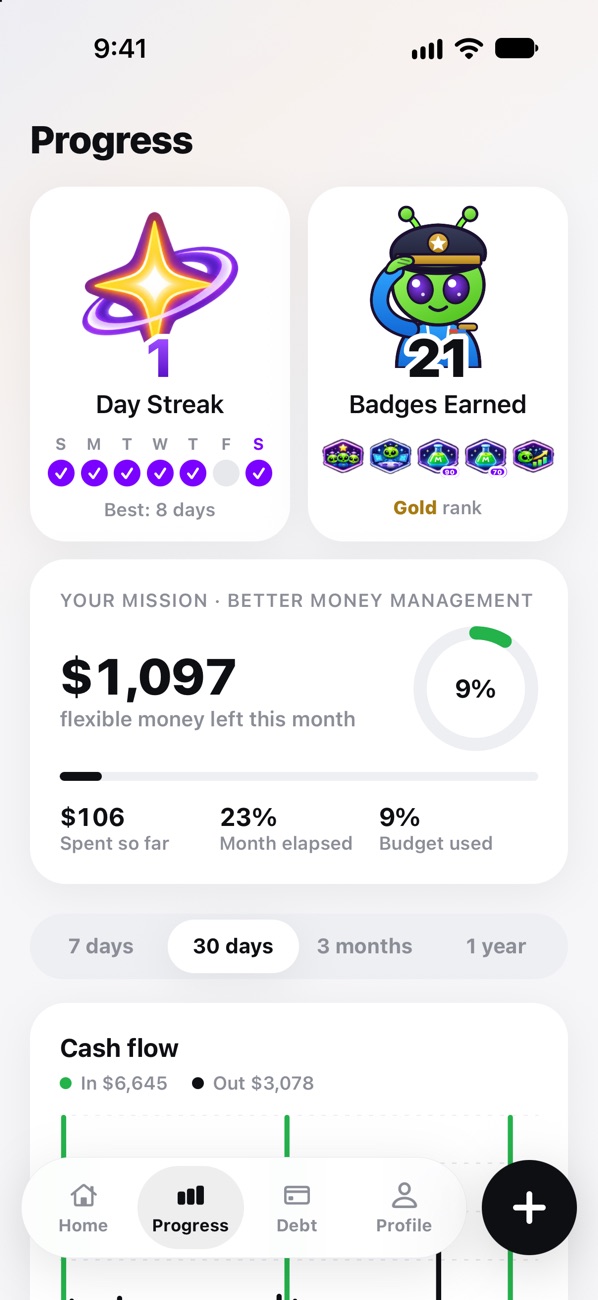
Count the days in a row you stayed under your number or put something away. A streak turns saving into a game you don’t want to lose. And when you hit a milestone, celebrate it. You earned that.
Why small daily saves beat big promises
“I’m going to save $5,000 this year” sounds good in January. By March it’s gone, because it depended on you feeling motivated every single day.
Small and automatic doesn’t need motivation. It happens on your worst week the same as your best one. And there’s something bigger going on: every day you do it, you’re proving to yourself that you’re somebody who saves. That changes how you see yourself, and that’s what really sticks.
You don’t need a bigger paycheck to start. You need a smaller first step.
Where should the money go?
A common order that works for a lot of people:
- A starter cushion. Even a few hundred dollars, so one surprise doesn’t land on a credit card.
- High-interest debt. Extra payments here usually save you more than a savings account earns.
- A real emergency fund. A common target is three to six months of your essential expenses. That’s the thing that lets you breathe.
- Your goals. The move, the trip, the business, the down payment.
That’s how you go from getting by to getting ahead, and eventually to having something to pass down.
What to do when you have a bad day
You’ll have one. You’ll blow past your number, or dip into savings, or skip a week. It happens to everybody.
The only rule is: don’t miss twice. One bad day is a bad day. Two in a row is the start of a new habit. Reset the next morning and keep it moving. If you don’t know where the money went, here’s how to find out in 30 days.
Metti is built to make all of this easier. It gives you a daily number based on your income, bills and savings goal, keeps it current as you spend, and tracks your streak so the wins are something you can see.
Common questions
How much should I save each day?
Start with an amount you won’t even feel. $3 to $5 a day is plenty to begin with. The habit matters more than the amount. Once it’s automatic, raise it a little every time your income goes up.
Is saving $5 a day really worth it?
Yes. $5 a day is $1,825 a year. That’s a car repair, a security deposit or a month of rent in a lot of places, sitting there instead of going on a credit card. And the habit you build is worth more than the money.
Should I save or pay off debt first?
A common approach is to always make your minimum payments, build a small emergency cushion first so one surprise doesn’t put you deeper in debt, then put extra money toward your highest-interest debt. Everybody’s situation is different, so treat that as a starting point, not advice for your exact case.
How do I save when money is already tight?
Start with the things that cost nothing to change: cancel what you don’t use, wait 24 hours before buying anything you didn’t plan, and save even $1 a day so the habit exists. When money is tight, knowing exactly what you can spend each day matters even more, because there’s less room for surprises.
This article is general education, not financial advice. Your situation is your own; for decisions about debt, taxes or investing, talk to a qualified professional.
 How Much Can I Spend Today? The Daily Budget Method
 Where Does My Money Go? How to Find Out in 30 Days